
At a glance
| Question | Short answer |
|---|---|
| Where ISM is mandatory | SOLAS chapter IX: cargo ships of 500 GT and over (which includes commercial yachts carrying 12 passengers or fewer) and passenger ships of any size. |
| Commercial, under 500 GT | Usually a simplified SMS under the flag's yacht code. For Red Ensign yachts, the REG Yacht Code. Check with your flag. |
| Private yachts | Generally outside ISM. Many keep an SMS anyway. |
| Who oversees it ashore | A designated person ashore (DPA) with direct access to the top of the company (ISM section 4). |
| How often it is checked | Internal audit at intervals of no more than 12 months (ISM 12.1), plus the master's periodic review (ISM 5.1.5). |
| What an auditor wants | Evidence: drill records by name, reports closed with a check that the fix worked, current procedures, signed reviews. |
Who has to run a safety management system
The ISM Code is made mandatory by SOLAS chapter IX for passenger ships of any size and for cargo ships of 500 GT and over. Under SOLAS a ship carrying 12 passengers or fewer is not a passenger ship, so a commercially operated yacht of 500 GT and over needs the full code: a document of compliance for the company, a safety management certificate for the yacht, and verification by the flag or its recognised organisation. SOLAS applies to ships on international voyages, and it leaves out pleasure yachts not engaged in trade (chapter I, regulation 3).
Below 500 GT the code is not mandatory in its own right, but that is not the end of it. Most flags apply a yacht code to commercially operated yachts, and those codes generally ask for a documented safety management system scaled to the yacht's size, often called mini-ISM. For yachts on the Red Ensign registers (the UK and the British Crown Dependencies and Overseas Territories, such as the Cayman Islands) the code is the Red Ensign Group Yacht Code. Whether the system is audited, by whom and how often varies from flag to flag.
A purely private yacht is generally outside all of this. Many well-run private yachts keep an SMS anyway, because the hazards are the same whatever the registry says. If the yacht moves between private and charter use, ask your flag what applies in each.
Your flag has the final word. This page is practical guidance, not legal advice: confirm what applies to your yacht with the flag, your DPA or your class surveyor.
What a safety management system needs in practice
The ISM Code is short and written in general terms. Its first twelve sections describe the system itself; the last four cover certification. On a small yacht each part can be modest, but each one needs to exist and to leave a record.
| Element | ISM Code | On a small yacht |
|---|---|---|
| Safety and environmental policy | Section 2 | A short policy from the company that the crew have read. |
| The company and the DPA | Sections 3 and 4 | Who is responsible for the yacht, in writing, and a designated person ashore with direct access to the top of the company. |
| The master | Section 5 | The master's authority set out in writing, and a periodic master's review of the system reported ashore. |
| Crew and training | Section 6 | Qualified, certificated crew, familiarisation before they start their duties, and training needs identified and met. |
| Procedures for key operations | Section 7 | Short procedures and checklists for the work that can go wrong: tender operations, bunkering, enclosed spaces, hot work, work aloft and overside. |
| Emergencies and drills | Section 8 | Emergency procedures, a muster list and a programme of drills and exercises. |
| Non-conformities, accidents, near misses | Section 9 | A way to report them, find out why, put them right and check the fix worked. |
| Maintenance | Section 10 | A planned maintenance system, with critical equipment identified and its standby arrangements tested. |
| Documents | Section 11 | Controlled documents: the current revision in use, old ones withdrawn, changes approved by the right person. |
| Audits and reviews | Section 12 | Internal audits, a review of whether the system works, and action on what they find. |
The designated person ashore
The DPA is the link between the yacht and the people ashore who are responsible for her. Section 4 of the code asks that the DPA has direct access to the highest level of management, and gives the DPA the job of monitoring the safety and pollution-prevention side of the yacht's operation and making sure resources and shore support are there when needed.
On a small yacht the DPA is often provided by a management company rather than the owner's own staff. Either way, check three things: the DPA's name and 24-hour contact are posted where the crew can find them; someone has tested recently that the DPA can actually be reached; and the DPA sees the yacht's reports of non-conformities and near misses, not only the annual audit.
Drills
Section 8 asks for programmes of drills and exercises. For the ships it covers, SOLAS chapter III, regulation 19 sets the familiar rhythm: every crew member takes part in at least one abandon ship drill and one fire drill every month, and both are held within 24 hours of leaving port if more than a quarter of the crew have not taken part in those drills on board that ship in the previous month. Codes for smaller yachts may set their own intervals; use the ones your SMS and flag give. Man overboard, enclosed space rescue, emergency steering and security drills go on the same programme.
The record is what an auditor reads: the date, the scenario, who was there by name, who was absent and why, what equipment was used and what went wrong. A drill that could not be held should be recorded as not held, with the reason and when it will be caught up, rather than left as a gap.
Non-conformities, accidents and near misses
Section 9 asks that non-conformities, accidents and hazardous situations are reported to the company, investigated and analysed, and that corrective action is taken, including measures to stop them happening again. It only works if the crew report small things, so make reporting quick and allow it in confidence.
A workable loop on a small yacht: anyone can report; the master triages; someone is named to put it right by a date; the cause is written down; and the DPA checks the fix worked before the report is closed. A report closed the day the work was done, with nobody checking whether it worked, is not yet a closed report.
Reviews and audits
- The master's review (section 5.1.5). The master periodically reviews the SMS and reports its deficiencies to the people ashore. Your SMS sets how often; write it down and sign it.
- Internal audits (section 12.1). On board and ashore, at intervals of no more than 12 months, which may be exceeded by no more than three months in exceptional circumstances. Auditors should be independent of the area they audit unless the size and nature of the company or ship make that impracticable (section 12.5). If someone from aboard audits, write down why.
- The company's review (section 12). The company periodically evaluates whether the system works and acts on what the audits and reviews found.
A yacht under the full code also has her safety management certificate verified by the flag or its recognised organisation: the certificate runs for up to five years, with an intermediate verification between the second and third anniversary (section 13). Below 500 GT, ask your flag what external audit, if any, applies.
What an auditor looks at
An auditor checks that the system written down is the system in use. Expect to be asked for:
- The drill records for the period, with names, and any drill not held with its reason
- Reports of non-conformities and near misses, each with its corrective action and the check that it worked
- The current revision of the SMS manual and procedures, and evidence the crew have read them
- Risk assessments with their review dates, and closed permits to work
- Safety meeting minutes and the actions that came out of them
- The last master's review and internal audit, with their findings closed
- The DPA's details and the certificates register
- Maintenance records, especially for critical equipment (see planned maintenance and running hours)
For a twenty-minute version to run yourself, use the yacht SMS audit checklist. For the code clause by clause, see the ISM Code and Kodo.
Keeping it the right size
A trap to avoid on a small yacht is a manual written for a much larger ship: hundreds of pages nobody reads, and procedures for equipment the yacht does not carry. A small SMS is better short and true. Write procedures for the work this yacht actually does, use forms the crew will actually fill in, and record things as they happen rather than rebuilding them before the audit.
How Kodo handles it
Kodo keeps the records a safety management system produces, added by the crew as the work happens. From the Kodo user manual for version 2.0.0:
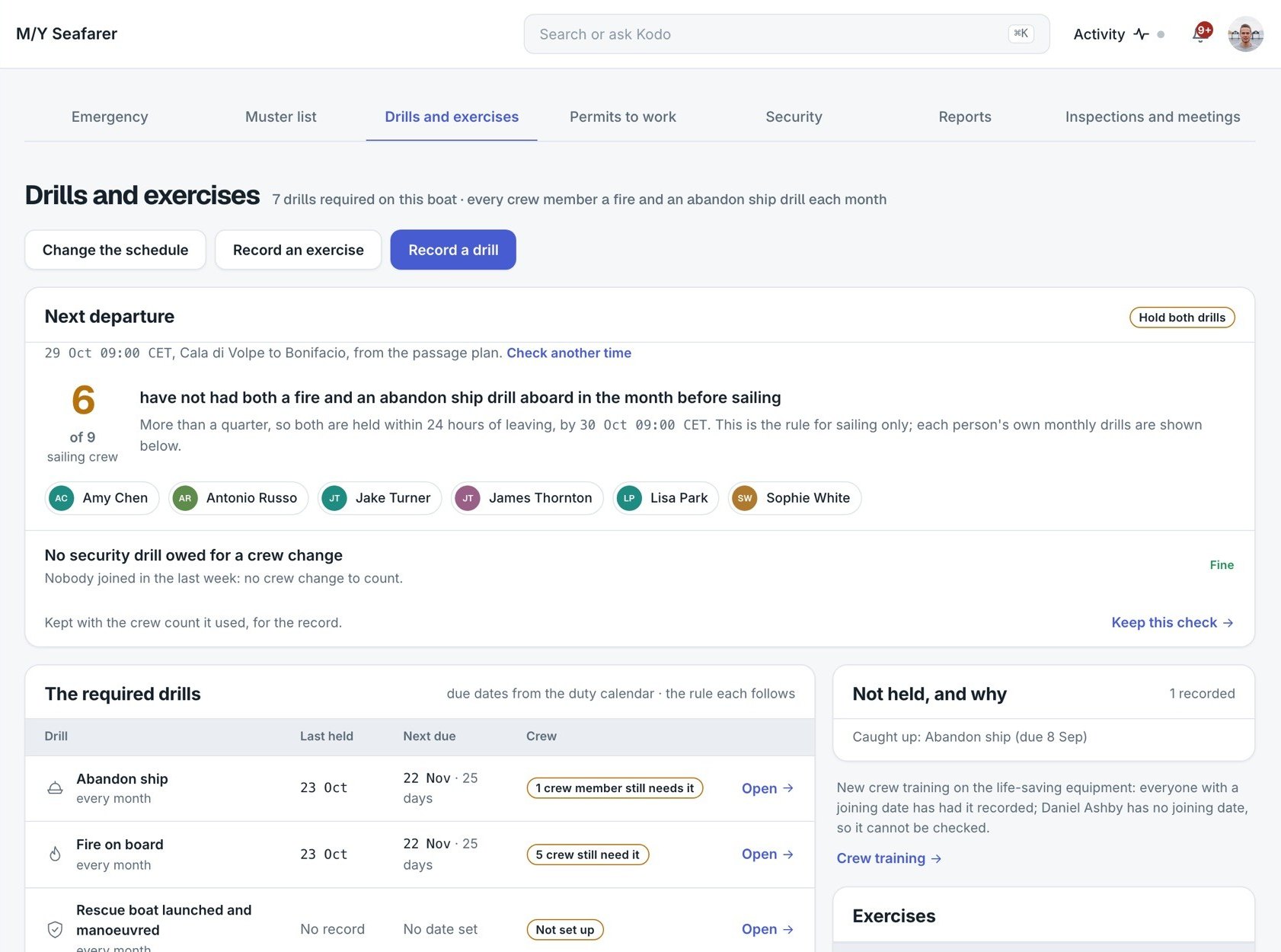
- Drills are recorded by name (present, absent or excused) with the scenario, where the yacht was, the equipment tested and what failed, and the master signs them in the logbook. Making a drill less frequent needs a reason, such as the flag rule or the SMS section. A drill not held is recorded with why and when it will be caught up.
- Reports of near misses, accidents and non-conformities can be made by anyone aboard, in confidence if they wish. Actions run in stages from containment to prevention, and only the DPA checks that the fix worked and closes the report.
- Controlled documents. A new revision takes effect only when its named approver (the master, the DPA or the office) approves it, never the person who proposed it. Received, understood and practically competent are kept as three separate records for each reader.
- Risk assessments, permits to work and safety meetings. The master approves assessments and signs the minutes. Changing an approved assessment clears the approval.
- Audits and the master's review. Kodo shows when the next internal audit is due, 12 months after the last, and refuses a later date unless an exceptional extension of up to three months is recorded with its reason. A self-audit is flagged and needs another person in the office to approve it. For the master's review Kodo fills in the year's facts; the master writes the conclusions and signs, and the office answers each point.
- The DPA's desk shows every report waiting on someone, the DPA's route to the top of the company, and each recorded test of reaching the DPA.
- The SMS audit pack puts the last 90 days of drills, incidents, certificates, controlled documents, permits, risk assessments and safety meetings in one PDF for a surveyor.
What it does not do: Kodo does not write your SMS manual, sends nothing to a flag or class society, and holds no class, flag or IMO approval. The audit register is kept for yachts with a management company in Kodo; the master's review works without one. Most records need a signal to save, while the emergency contacts and procedures stay on the device for use without one. More on the crew and safety page.
Sources
- International Safety Management (ISM) Code, IMO Resolution A.741(18), as amended: sections 2 to 13.
- SOLAS 1974, as amended: chapter IX (management for the safe operation of ships), chapter III regulation 19 (emergency training and drills), chapter I regulation 3 (exceptions).
- Red Ensign Group Yacht Code (REG Yacht Code), Parts A and B, as amended.