
At a glance
| Question | Short answer |
|---|---|
| Kinds of interval | The calendar, running hours, or whichever comes first. Some equipment counts uses, such as starts or lifts. |
| The unit of work | A job card: what to do, the steps, readings with limits, the parts, and a signature. |
| Running hours | Read on a fixed rhythm. A lower or impossible reading is explained, never overwritten. |
| Late work | Postponed on record with the reason and who agreed. Class and statutory jobs need class's or the flag's agreement. |
| Critical equipment | Identified, with standby tests and critical spares aboard (ISM Code 10.3). |
| Class reference | IACS UR Z20 (Rev.1 July 2018), planned maintenance scheme for machinery. |
What a planned maintenance system is
A planned maintenance system (PMS) has three parts: a list of every machine and system aboard, each with a way to identify it; a plan that says what work each one needs and how often; and a record of every job done. The plan keeps the work ahead of the machinery. The record is what proves it, to the owner, the next chief engineer, a buyer's surveyor and class.
Section 10 of the ISM Code asks the company to maintain the ship in line with the rules and its own requirements: inspections at appropriate intervals, non-conformities reported with their possible cause, corrective action taken, and records kept. On a commercial yacht the PMS is how that is done. If your yacht is under 500 GT, see running a safety management system under 500 GT for where maintenance sits in the wider system.
Calendar or running hours
Every job needs an interval, and choosing the right kind matters more than the number.
| Interval | Use it for | For example |
|---|---|---|
| Calendar | Things that age or fall due whether used or not | Safety equipment servicing, items tied to a survey or certificate, seasonal checks |
| Running hours | Machinery that wears with use, where the maker gives hours | Main engines, generators, watermakers, compressors |
| Whichever comes first | Machinery with hours from the maker and a time limit for when it runs little | An engine service at the maker's hours, or after a set number of months if the engine has barely run |
| Uses | Equipment that wears per operation rather than per hour | Crane lifts, tender launches, engine starts |
| Date on the item | Items that carry their own expiry | Flares, hydrostatic releases, batteries |
Two details catch yachts out. First, decide whether each job's next date counts from the day it was done or stays on its original anniversary. A statutory or class job usually keeps its anniversary, so a late service does not quietly push the next one back. Second, a reminder that comes up early is not extra time: a job past its due point is overdue.
Running hours a surveyor will trust
A running-hours plan is only as good as its readings.
- Read the meters on a fixed rhythm, for example with the daily engine-room round, so jobs fall due on real hours rather than last month's estimate.
- When a meter is replaced, record the old meter's last reading and the new one's first, so the machine keeps its lifetime hours and the jobs do not jump.
- A reading lower than the last one, or more hours than time has passed, is a mistake or a meter change. Do not overwrite it silently; write down what happened.
- Know which machines have not been read lately. A stale reading makes an hours job look further away than it is.
Job cards and the record of work
A job card turns the maker's manual into the steps the crew follow aboard: what to do, the readings to take with their limits, the parts needed, and whether a risk assessment or a permit to work comes first. The completed card is the record. For each job done, keep:
- the date, and the machine's running hours at the time
- what was done and what was found, including any reading outside its limits
- the parts used
- who did the work and who signed for it (a contractor's work still needs someone aboard to sign)
- any later correction, kept beside the original rather than written over it
Work on critical machinery, class items and jobs required by a rule is worth a second check, by the chief engineer or the captain, before it counts as done.
Defects, postponements and overdue work
Unplanned work belongs in the same system. A defect is raised against the machine it affects, repaired, and checked by someone other than the person who repaired it before the machine goes back into service. If the yacht has to run with a limit meanwhile (a pump not to be relied on, a generator kept off line), write the limit down with what keeps her safe until it is lifted.
When a planned job cannot be done on time (parts not aboard, on charter, waiting for the yard), postpone it on record: the original due date, the new one, the reason, what keeps the yacht safe meanwhile, and who agreed. A job required by class or a statutory rule needs the class society's or the flag's agreement, and its reference belongs with the job. A row of overdue jobs with no explanation is hard to defend in front of a surveyor.
Spares and critical equipment
Section 10.3 of the ISM Code asks the company to identify equipment whose sudden failure could lead to a hazardous situation, and to take specific measures for its reliability, including regular tests of standby arrangements and of equipment not in continuous use. In the PMS that means:
- a list of critical equipment, with why each item is critical
- a regular standby test for each item on the plan, or a written reason it needs none (for example because it runs continuously and is watched)
- a minimum number of critical spares aboard, counted, with each part used recorded against the job it went on
What a surveyor wants to see
- The equipment list, with each item identifiable aboard
- The plan, with intervals that follow the maker's recommendations, or a recorded reason where they differ
- Any machine's history on request: jobs done, hours at each service, defects and repairs
- Overdue and postponed jobs, each with its reason and who agreed
- Running hours that are current
- Critical equipment, its standby tests and its spares
- The makers' manuals aboard for the machinery
Where class surveys the machinery under an approved planned maintenance scheme, IACS UR Z20 (Rev.1 July 2018) is the unified requirement class societies work from for a machinery PMS; ask your class society what it needs from yours. For the requirements clause by clause, see planned maintenance and Kodo.
This page is practical guidance, not class or legal advice. Your class surveyor, your flag and your DPA have the final word on what your yacht needs.
How Kodo handles it
From the Kodo user manual for version 2.0.0:
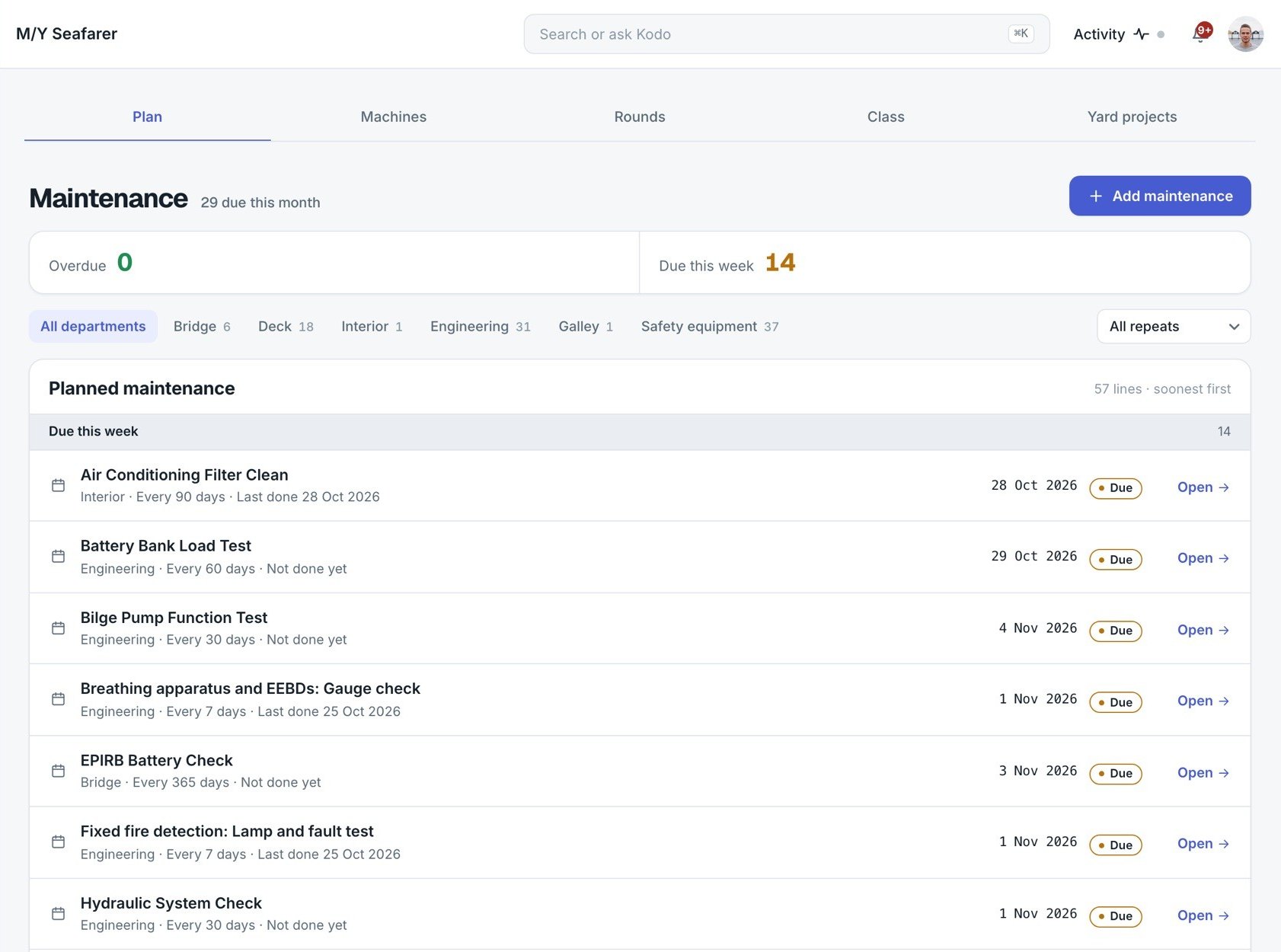
- The plan. Each line repeats by the calendar (real calendar months), by days, by running hours, by whichever comes first, by uses such as starts, launches or lifts, or once. A job can keep its fixed due date or count from the day it was done. There is no grace period: a job past its due point is overdue. Only the chief engineer, the master, or someone the chief engineer authorises changes the machinery lines.
- Running hours. Every reading is kept with where it came from. A lower reading needs a reason, and from anyone other than the chief engineer, the captain, an officer or a head of department it waits for review. A meter change keeps the machine's lifetime hours, a machine not read lately shows as stale, and an hours job shows the date it is likely due from the last 30 days of use. The daily round of readings can be saved without a signal.
- Job cards come from standard jobs kept in versions, with steps, readings with limits, calibrated instruments, and a risk assessment or permit where one is needed. A job cannot be marked done until its card is finished.
- The record of work keeps who did the work apart from who signed it, with the running hours, parts and cost. A correction keeps the original beside it. Work on critical machines, class items and jobs that cite a rule waits for a second person to approve it.
- Postponements. A routine job's due date is moved with a reason on record. A critical, class or rule-based job needs a postponement decided by the office, or by the master where there is no management company, and a class or rule-based one also needs the class society's or the flag's reference. The original due date stays beside the new one.
- Defects are verified by someone other than the person who repaired them. A machine goes back into service only on the chief engineer's or the master's decision, and only the master lifts a restriction.
- Spares and critical equipment. Stock changes only through recorded movements, and a part used on a job is recorded against it. Kodo shows critical spares below their minimum, each critical machine's standby test and when it is due, and the reviews of the critical list.
- For class and the surveyor. Each machine has a history page that downloads as a PDF, a data file or a spreadsheet. The class page keeps the survey cycle and credits, prepares the annual report to class as a PDF, and records the surveyor's annual review.
What it does not do: Kodo is not a class-approved planned maintenance scheme and holds no class, flag or IMO approval. A surveyor has no login of their own and works from the PDFs and exports. The plan itself needs a signal to change. Coming from another maintenance system? Send us what you can export and we move it across with you; old records stay marked as legacy records and are never shown as signed in Kodo. More on the maintenance page.
Sources
- IACS Unified Requirement Z20, Planned Maintenance Scheme (PMS) for machinery, Rev.1 July 2018.
- International Safety Management (ISM) Code, IMO Resolution A.741(18), as amended: section 10 (maintenance of the ship and equipment).
- SOLAS 1974, as amended: chapter IX (which makes the ISM Code mandatory).