
At a glance
| Question | Short answer |
|---|---|
| Who inspects | The port State's officers, working under a regional agreement such as the Paris MoU (Europe and the North Atlantic) or the Tokyo MoU (Asia-Pacific) |
| Which yachts | Mainly commercially operated yachts; SOLAS does not apply to pleasure yachts not engaged in trade |
| Where they start | Certificates and documents, then the condition of the yacht and how the crew work |
| What sinks an inspection | Expired papers, records that do not match each other, and crew who cannot show a drill or procedure |
| The worst outcome | Detention until serious deficiencies are put right |
| Final word | The port State and the flag state, or a qualified adviser for your case |
What port state control is
Port state control lets a country check foreign ships in its ports against the international conventions: SOLAS, MARPOL, STCW, the Load Lines Convention and MLC 2006, among others. The procedures inspectors follow are set out by the IMO in Resolution A.1185(33), and each regional agreement adds its own. A first inspection checks the certificates and documents and the general condition of the ship. If the inspector finds clear grounds, it becomes a more detailed inspection.
For yachts, whether a convention applies depends on size, use and flag. A commercially operated yacht is in scope; a private yacht mostly is not, though the port State's own rules still apply in its waters.
What inspectors ask for on a yacht
| Area | What they typically ask for | Main rule |
|---|---|---|
| Ship's certificates | Registry, tonnage, load line, safety equipment and construction, radio, IOPP, IAPP, sewage, anti-fouling, the insurance certificates, the SMC with a copy of the DOC, the ISSC, the MLC certificate and DMLC | SOLAS, MARPOL, Load Lines, ISM, ISPS, MLC |
| Crew | Crew list, minimum safe manning document, each person's certificate of competency, flag endorsement, medical and STCW training | STCW Regulation I/4, SOLAS V/14 |
| Hours of rest | Each seafarer's records, signed monthly, and the table of shipboard working arrangements posted where crew can see it | MLC Standard A2.3, STCW Code A-VIII/1 |
| Record books and logs | Oil record book, garbage record book and plan, fuel changeover log, the official logbook | MARPOL Annexes I, V and VI |
| Drills | The drill log with dates and who took part; the inspector may ask to see a drill | SOLAS III/19 |
| SMS evidence | The safety management manual, the last internal audit, non-conformities and their corrective actions, the master's review, the DPA's details | ISM Code |
| MLC items | Seafarers' employment agreements, wage records, the complaints procedure, food and water inspections | MLC Titles 2 to 5 |
Many port States publish their own list of certificates and documents to be checked. In the European Union it is Annex IV of Directive 2009/16/EC on port State control.
How to prepare an inspection pack
- Certificates. Run through the register: nothing expired, every survey inside its window, originals aboard, any electronic certificate verifiable with its issuer.
- Crew. Compare the crew list with the safe manning document, then check each person's certificate, endorsement, medical and basic safety refreshers. See tracking crew certificates.
- Hours of rest. Last month signed by master and crew member, this month up to date, the table of working arrangements posted. See the hours of rest template.
- Record books. Up to date, each completed page signed by the master, and nothing that contradicts the logbook.
- Drills. The last fire and abandon ship drills, with names, and anyone who missed one.
- SMS. The last internal audit, open non-conformities with owners and dates, the master's review, the DPA's contact posted.
- MLC. Employment agreements, the complaints procedure, the master's food and water inspections.
- Open items. Defects, conditions of class and any dispensation, each with the letter or reference behind it.
- One folder. Paper or digital, in that order, and one officer who knows where everything is and goes round with the inspector.
The SMS audit checklist is a good monthly test of the same evidence.
Common findings
The regional agreements publish what their inspectors find. The Paris MoU's annual reports group deficiencies by area, and fire safety has been among the largest areas in recent years. The Paris MoU and Tokyo MoU also run concentrated inspection campaigns on one subject at a time, which show where inspectors will look hardest:
- Paris MoU and Tokyo MoU, concentrated inspection campaign on STCW, 1 September to 30 November 2022: crew certificates, watchkeeping and rest.
- Paris MoU and Tokyo MoU, concentrated inspection campaign on fire safety, September to November 2023.
- Paris MoU, concentrated inspection campaign on STCW hours of rest, 2014 (results published June 2015).
On yachts in particular, the things that tend to go wrong are plain: a certificate that lapsed between charters, rest records that do not match the logbook or the watch pattern, drills logged without names, record book pages unsigned, and corrective actions written down but never closed. None of these needs a new system to fix. They need someone to check before the inspector does.
How Kodo handles it
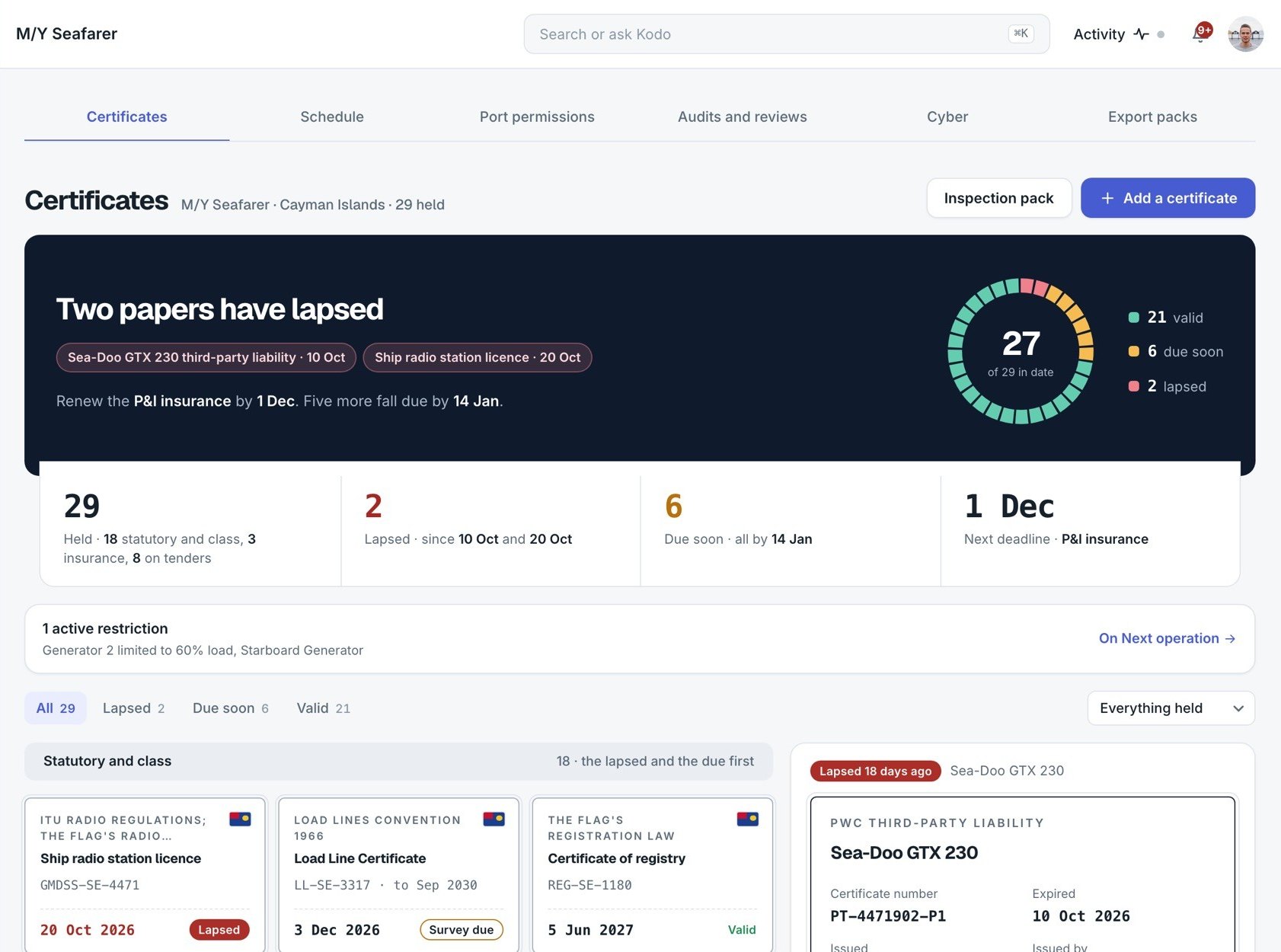
- The certificate register. Every dated paper the yacht depends on, worst first: lapsed, renew soon, valid. A second list works out from the yacht's profile which certificates she needs and shows any that are not held. Survey windows are tracked, and a missed window reads "validity in question until flag or class decides". Scans are kept as uploaded, with a fingerprint and a history of every change.
- The inspection pack. Built for a port State, flag or class inspector as a file that opens offline in any browser without a Kodo account. It carries the certificates, where each kind of official record is kept, the drills with who was there by name, drills not held, the master's weekly inspections, permits to work, open defects and authority cases, and a summary of hours of rest. It lists what is missing, every file has its fingerprint, and each release is recorded with who received it and why.
- A copy on the device. The Ports tab keeps a pack of the certificates, permissions and coming port plans on the device, with the time it was put together, for an inspection with no signal.
- Record books and logs. The oil record book (Part I), garbage record book, fuel oil changeover record and, where it applies, the ballast water record book, each exported as a complete PDF. The logbook exports the same way, and each signed month of hours of rest prints as a form.
- Afterwards. The office records a port State control visit on the Audits tab with its findings, and a finding against a defect is recorded as an authority case with its reference and due date.
Kodo holds no class, flag or IMO approval. Every pack says: "A company record built by Kodo. It is the official record only for a record family declared kept in Kodo; Kodo holds no class, flag or IMO approval." Kodo's MARPOL books always say "Company record, not the official record book.", so the flag's book stays the official one. The inspection pack does not hold crew certificates or the crew list (those are shown online and prepared separately), and the register itself reminds you to check the original certificate before relying on it for port State control.
More on certificates and manning, hours of rest, how records are kept and crew and safety in Kodo.
Sources
- IMO Resolution A.1185(33), Procedures for port State control, 2023, adopted 6 December 2023.
- Paris Memorandum of Understanding on Port State Control (1982, as amended) and its annual reports.
- Tokyo Memorandum of Understanding on Port State Control in the Asia-Pacific Region (1993, as amended).
- Paris MoU and Tokyo MoU, concentrated inspection campaign on STCW, 1 September to 30 November 2022; Paris MoU report published 1 June 2023.
- Paris MoU and Tokyo MoU, concentrated inspection campaign on fire safety, 2023.
- Directive 2009/16/EC of the European Parliament and of the Council on port State control, Annex IV (list of certificates and documents).
- SOLAS 1974, as amended: Regulation I/3 (exceptions), III/19 (drills), V/14 (manning).
- MARPOL, Annexes I, V and VI; IMO Resolution MEPC.312(74), guidelines for the use of electronic record books under MARPOL.
- STCW Convention and Code, 1978, as amended: Regulation I/4 and Section A-VIII/1.
- Maritime Labour Convention, 2006, as amended: Standard A2.3 and Title 5.
- International Safety Management (ISM) Code.
This page is practical guidance, not legal advice. The flag state and the port State have the final word.