
At a glance
| What it is | The boat's record of one charter: the contract, the people, the plan, the money and anything that happened. |
| Built around | The fully signed MYBA charter agreement and its addenda, in the edition your broker used. |
| Who keeps it | The captain, with the chief stew for guest details and whoever keeps the boat's accounts for the APA. |
| The money | The APA is an advance from the charterer, spent at cost and reconciled against receipts. It is not a fee or a cost to the boat. |
| Closes with | The APA statement with every receipt, signed by the charterer before they leave. |
This page paraphrases common practice and MYBA's published guidance for captains and brokers. The contract you signed, and its addenda, are what govern your charter. It is practical guidance, not legal advice.
The contract, and what it means aboard
MYBA's guidelines for captains say a fully signed copy of the charter agreement should be on board for every charter, and that the captain should read it, with its addenda, and run the accounts to match. Note the edition printed on the form: MYBA has published more than one, and your broker can confirm which one applies.
The terms that change what the crew do:
| Term | What it means for the boat |
|---|---|
| Charter period | The dates and times the charterer has the yacht. Prep before and the turnaround after sit outside it. |
| Delivery and redelivery | Where the yacht is handed to the charterer and where she is handed back, and any fee for getting there. Fuel and any delivery or redelivery costs are explained to the charterer at the start. |
| Charter fee | MYBA's guidance for captains lists what it covers: the yacht and her equipment, basic consumables, the ship's laundry, crew wages, uniforms and food, and insurance. |
| APA | The advance for running expenses the charterer pays at cost: fuel (tenders and toys included), guest food and drink, berths and harbour charges, agents, communications if not included, personal laundry and special equipment. |
| Security deposit and addenda | The deposit the contract sets, and any changes agreed to the standard form. Read the addenda with the main agreement before the guests arrive, not after. |
The guests: list, passports and preference sheets
- The guest list, with the named charterer. MYBA's guidance has the captain confirm to the central agent that the charter started as contracted: the port, the date and time, the number of guests and the named charterer.
- Passport details for every guest. MYBA's guidance for brokers says the broker should send the captain a full preference document in good time, with all guests' details, passport information, and medical and mobility issues. The same guidance summarises the agreement as making the charterer responsible for the guests' visas.
- Preference sheets: food and drink, allergies and their severity, cabins, routines and occasions. Treat allergies as safety items for every department, not as interior notes.
- Confidentiality. MYBA's guidance for captains says guest contact details are not passed to the central agent or the owner, and the booking broker's correspondence is not copied to the central agent. Keep passport and medical details where only the people who need them can see them.
The itinerary, and every change to it
Keep the agreed plan and each version after it, with the date and the reason for the change. MYBA's guidance for captains says changes with guests aboard should be discussed first with the central agent, the broker and the client, because a change of route can change the tax position. Note what was agreed and with whom.
Port clearance: crew and passenger lists
Under the IMO FAL Convention, the standard crew list is FAL Form 5 and the passenger list is FAL Form 6, signed by the master or an officer the master authorises. What each port wants, and in what format, varies by country: ask the agent before arrival. Keep each list as it was sent, with its date, because the crew and guests aboard change during a season and the list must match the day it was used.
Incidents, damage and the logbook
- Report significant events at once. MYBA's guidance for captains says breakdowns, crew changes, accidents and other significant incidents go immediately to the broker and the stakeholder. Keep a note of what happened, when, and who was told.
- Damage by guests. Tell the broker and central agent, show the charterer, take photographs, get quotes, withhold an amount from the APA and have the charterer sign the note before they leave. The same guidance says damage not raised during the charter should not be charged later.
- The logbook. A copy of the log for the charter period goes to the broker on request.
The APA, from first deposit to final statement
MYBA's guidance makes the captain answerable to the charterer for the APA, including money spent by the crew. The captain keeps the charterer informed of the spending and may ask for more funds when it runs low. In practice that means:
- Every spend recorded with its category, how it was paid and its receipt, as it happens, not rebuilt from a box of receipts at the end.
- Large amounts of APA cash avoided. MYBA's guidance notes that many places require a customs declaration for cash above EUR 10,000; cards or transfers are better for large sums.
- Suppliers told that invoices arriving after the charter ends are not normally payable.
Closing the APA
- The statement, with all receipts. Known bills still to come are listed, with a realistic amount withheld to cover them.
- Provisions bought and not used, wines and spirits above all, with a reminder that goods bought without duty need a customs declaration to leave the yacht.
- The fuel explained.
- The charterer signs before leaving. A copy goes to the broker on request, and a balance can be refunded by bank transfer if the charterer prefers.
- The gratuity is at the charterer's discretion and is never asked for. MYBA's guidance is clear on that.
- The debrief goes to the booking broker, not the central agent.
The charter file as a checklist
| When | Keep |
|---|---|
| Before | Fully signed agreement and addenda; guest list and passport details; preference sheets with allergies; the itinerary; the APA received, with evidence of how it arrived. |
| Start | Confirmation to the central agent that the charter started as contracted; the guest briefing given; fuel and delivery costs explained; crew and passenger lists for the first port. |
| During | Every APA spend with its receipt; each itinerary change and who agreed it; each crew and passenger list as sent; incidents and damage, with photographs and the charterer's signature. |
| End | The signed APA statement with all receipts, bills to come and amounts withheld; provisions not used; the fuel explained; how the balance was settled; the debrief to the booking broker. |
How Kodo handles it
In Kodo each charter is a trip with its own guests, plan, galley and money, and it keeps a charter file beside it:
- A checklist per charter with five standard items: the charter agreement reference and status, guest identity and travel references, guest preference history, the itinerary and operational extract, and the crew brief and handover extract. The captain or manager links each item to a record the boat already holds and approves it. Evidence that changed after it was linked cannot be signed off. The screen says plainly that MYBA wording is not copied there, and that a draft is not an executed contract.
- Each section seen only by the roles allowed to see it. Officers read the operations section; the owner sees the contract and operations, not the guests' identity details.
- The guests: the guest list with who is aboard, ashore or on the tender, the allergy and dietary panel, the preference sheets, the port clearance card and the charter documents.
- Crew and passenger lists (FAL 5 and FAL 6) drafted from the boat's records, checked by a second person before export. Kodo never submits anything to an authority.
- The APA logged with category, how it was paid and the receipt; each entry is fixed after 15 minutes and corrected only by a signed entry. At the end the account is closed with the unused provisions and the fuel explained, and the lead guest signs in their own app or on the crew's device with a witness. Kodo moves no money.
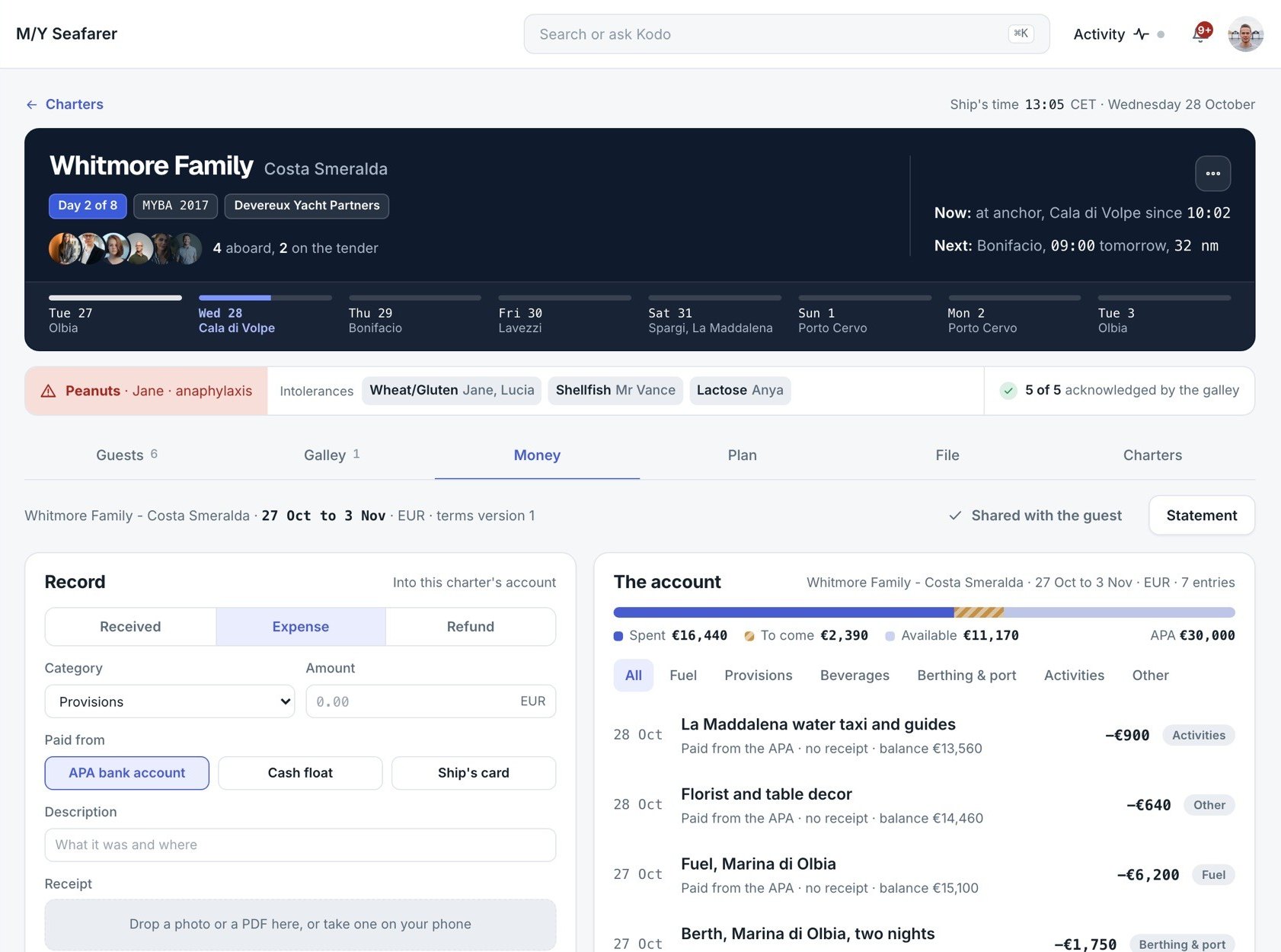
More on the guests and charters side of Kodo, and on how the money is kept. For the crew change at the end of a season, read the crew handover guide.
Sources
- MYBA charter agreement: the edition and addenda named on your own signed contract.
- MYBA, Guidelines for Charter Yacht Captains and Crew, April 2018.
- MYBA, Guidelines for Retail Charter Brokers and Charter Managers, January 2019.
- IMO, Convention on Facilitation of International Maritime Traffic (FAL Convention), 1965, as amended: Form 5 (crew list) and Form 6 (passenger list).