
At a glance
| Joining | Passport and visa, signed employment agreement, certificates and flag endorsement, medical, safety familiarisation, crew list updated. |
| Leaving | Handover, sign-off date, travel home, crew list updated, record of employment. |
| MLC in one line | Every seafarer has a signed seafarer employment agreement, with time to read it first and a copy on board. |
| Schengen short stays | 90 days in any 180-day period, the day of entry and the day of exit both counted. |
| Whose call | Visa and Schengen status depend on nationality, visa type and local practice. Ask the authorities or an adviser, not a website. |
This page explains the general rules and what to ask. It is not legal or immigration advice: your flag, your yacht's use and each crew member's own papers decide what applies.
Joining: what to check and record
| Item | What to check |
|---|---|
| Sign-on | The date and place of joining, and the role. It is the start of the record every other date counts from. |
| Passport | Valid for the planned stay and the itinerary. Record the number, nationality, issuing country and expiry, and keep it where only the people who need it for port clearance can see it. |
| Visa | The right visa for the countries on the itinerary, and what it allows. MYBA's guidance for captains makes the captain responsible for crew holding the right visas for a charter itinerary. |
| Employment agreement | Under MLC 2006 a seafarer employment agreement, signed by the seafarer and the shipowner or a representative, after the seafarer has had the chance to read it and take advice. Both keep a signed original and a copy is available on board. |
| Certificates and medical | The certificates the role needs, and a valid medical certificate before starting work. An officer serving under a flag other than the one that issued their certificate needs that flag's endorsement (STCW Regulation I/10). |
| Safety familiarisation | Given before they take up duties (STCW Regulation VI/1), with the date and who gave it. |
| Crew list | Updated for the next port clearance. The IMO standard crew list is FAL Form 5, signed by the master or an officer the master authorises. |
Leaving: what to close out
- Handover. Start it early and sign it off against a list. The crew handover guide covers what a real one holds, department by department.
- Sign-off. The date and place of leaving, recorded the same way as the sign-on.
- Record of employment. MLC 2006 gives every seafarer a record of their employment on board. It must not contain any statement about the quality of their work or their wages.
- Travel home. MLC 2006 (Regulation 2.5) sets when a seafarer is entitled to repatriation at no cost to them, such as when the agreement ends while they are abroad. Your flag and the agreement set the detail.
- Crew list and immigration. Update the crew list, and ask the agent how this port records a crew member leaving, so the exit is on record for their day count.
Passports and visas
A passport and a visa decide where a crew member can go, not just whether they can join. Before each new cruising area, check every crew member's passport expiry and visas against the itinerary, and note what each visa allows: a visa to visit is not always a visa to work. Rules differ by country and can turn on whether the yacht is private or commercial, so ask the consulate or the agent for each country, and keep the answer with the date you got it.
Schengen: 90 days in any 180
The general rule, as the European Commission states it: a non-EU national on a short stay may spend up to 90 days in any 180-day period in the Schengen area.
- The window rolls. On any day, look back over the last 180 days and count every day spent in the Schengen area. The day of entry and the day of exit both count.
- It is for short stays. EU citizens are not counted this way, and the Commission's short-stay calculator is not for people holding a residence permit or a long-stay (type D) visa.
- Stamps are being replaced. The EU's Entry/Exit System (EES) records the entries and exits of non-EU short-stay travellers at external borders electronically, and the Commission says it has been fully operational since 10 April 2026.
- Keep your own log. Crew cannot see their EES record themselves. The Professional Yachting Association advises crew to keep their own record of every entry and exit, with the evidence: the stamp or EES record, the stamped crew list, the boarding pass.
- Ports differ. Some record crew as leaving when they join a yacht; EU guidance to carriers says exit checks happen at the real point of departure from the Schengen area. Ask the local immigration office or the agent.
A worked example of the general rule
| Date (2026) | What happens | Days counted |
|---|---|---|
| 1 March | Enters the Schengen area | Day 1 |
| 30 April | Leaves the Schengen area | 61 days used |
| 1 July | Enters again. The last 180 days still hold all 61, plus today | 62 used, 28 left |
| 29 July | The last day of a continuous stay: the March and April days are still inside the window | 90 used |
The Commission says its own calculator's results are not legally binding. Treat any count, including this one, as an estimate to plan with.
Check your own case. This is the general rule, not advice for any person. Each crew member should check their own nationality, visa type and any seafarer or yacht-specific arrangements with the authorities of the country they are in, or with an immigration adviser.
Records to keep
| Record | Why |
|---|---|
| Signed employment agreement, and each later version | MLC 2006 wants a copy available on board for inspection. |
| Sign-on and sign-off dates | They anchor sea time, leave, pay and the crew list. |
| Certificate checks and flag endorsements | Who checked what, and when, before the person stood a watch. |
| Safety familiarisation | The date and who gave it. |
| Each crew list as sent | It must match who was aboard on that day. |
| Entries and exits, with evidence | The only way to show a Schengen day count without the EES record. |
| Visas, with what each allows | Checked against each itinerary, not once a year. |
| The signed handover | So the next person starts from a record. |
How Kodo handles it
In Kodo each crew change is one record that moves step by step, and the checks are made by someone other than the person they are about:
- Joining: proposed, evidence review, joined, cleared for duty, handover, signed off. A person is cleared for duty only when every certificate their role needs has been reviewed and accepted by someone else and their safety familiarisation is recorded. A watch refuses anyone who is not cleared.
- Joining and leaving checklists: identity, travel document, employment agreement and flag endorsement on joining; handover and travel document on leaving. Each item is missing, failed, resolved or not applicable, with the document that shows it. The screen says it is not legal clearance.
- Employment agreements saved by the crew member and activated by a different authorised person against the signed document, with rotation and leave beside them.
- Passports stored encrypted, seen only by the person and the captain or an officer of their boat for port clearance, and never kept on a device.
- Schengen days and visas: each entry and exit recorded with its evidence, and an estimate of days used and left in the rolling 180 days, both days of each crossing counted. No count is drawn until the person's basis (short stay, EU citizen, residence permit and so on) has been reviewed by the captain or manager. Visas are checked against a trip's dates. Joining or leaving the yacht is not treated as a border crossing, and the screen says it does not decide whether a border officer will admit anyone.
- The crew list (FAL 5) drafted from who is aboard on a date, with each passport shown as valid, expired or missing, checked by a second person before export. Kodo never submits it to an authority.
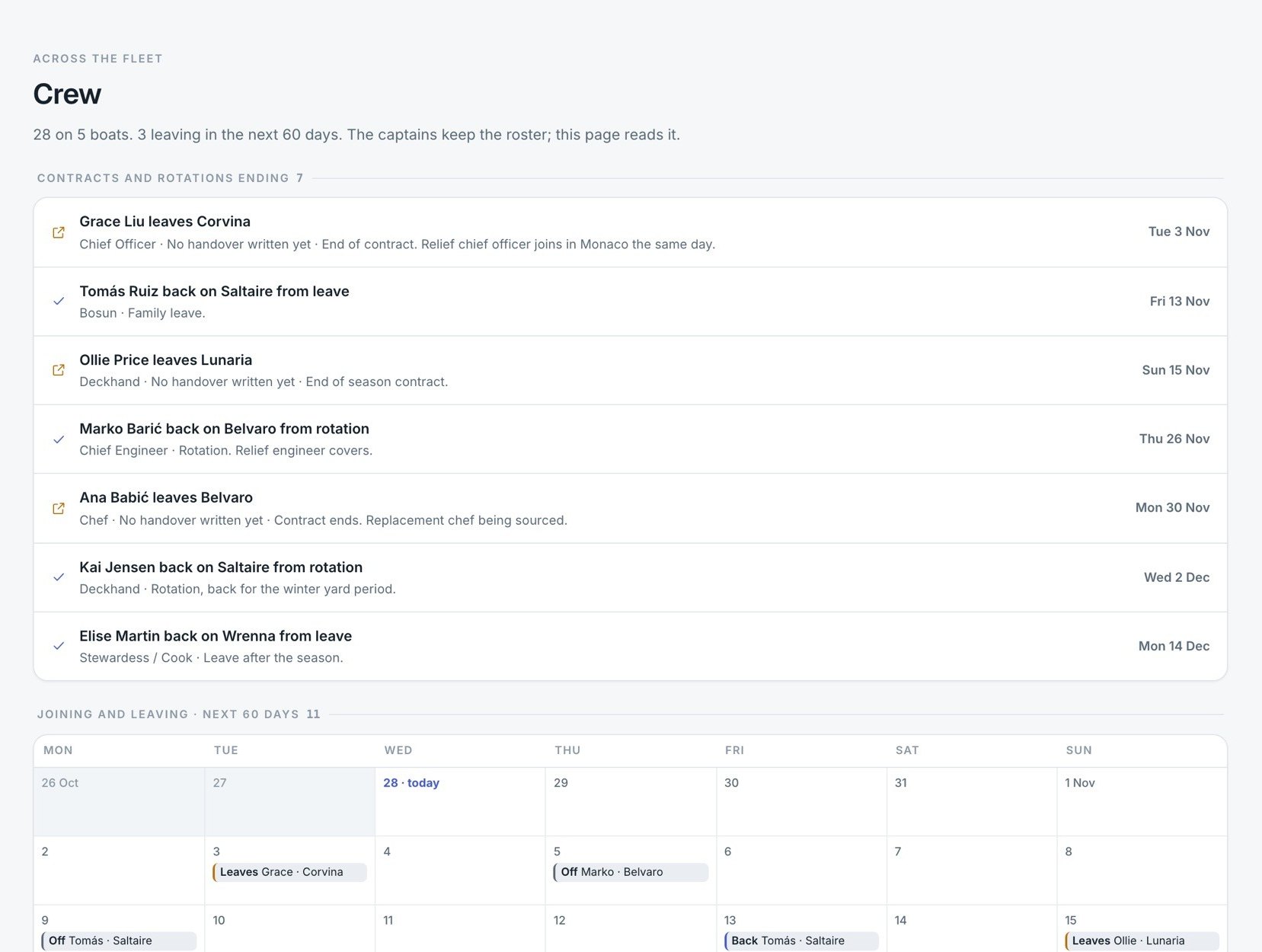
- Handover written from the boat's own record, checked by a senior crew member, issued to a named person and signed by them. The office sees who is leaving with no handover written yet.
See how Kodo keeps the handover, and Kodo's MLC page.
Sources
- ILO, Maritime Labour Convention, 2006, as amended: Regulation 2.1 and Standard A2.1 (seafarers' employment agreements and the record of employment), Standard A1.2 (medical certificates), Regulation 2.5 (repatriation).
- IMO, STCW Convention, 1978, as amended: Regulation I/10 (recognition of certificates) and Regulation VI/1 (safety familiarisation).
- IMO, Convention on Facilitation of International Maritime Traffic (FAL Convention), 1965, as amended: Form 5 (crew list).
- European Commission, Short-stay calculator (checked 18 October 2026).
- European Commission, Entry/Exit System questions and answers (checked 18 October 2026).
- eu-LISA, Carriers Working Group meeting summary, October 2024 (exit checks at the real point of departure).
- Professional Yachting Association, as reported by SuperyachtNews, April 2026 (crew keeping their own entry and exit log).
- MYBA, Guidelines for Charter Yacht Captains and Crew, April 2018 (crew visas for the charter itinerary).