
Three things that get mixed up
Most arguments about crew time on a yacht come from treating three different things as one. Keep them apart in the record and most of the arguments go away.
| What it is | Where it is set | |
|---|---|---|
| Rotation | The pattern of time aboard and time off, for example equal time on and off for a role that has a relief. | The employment agreement, or the yacht's policy |
| Annual leave | Paid leave the crew member earns by working. Under MLC 2006, at least 2.5 calendar days for each month of employment. | MLC Standard A2.4, the flag's law and the agreement |
| Absence | Time off that is neither, such as sickness or a family emergency. Under the MLC, justified absences are not counted as annual leave. | MLC Standard A2.4, the agreement |
On a yacht with rotation, a crew member's time off is often rotation, not leave. Whether leave is paid on top of rotation, included in it, or paid out depends on the employment agreement and the flag's law. Write down which applies, in the agreement, before the season starts.
What the rules say
- Annual leave. MLC 2006 Regulation 2.4 and Standard A2.4: paid annual leave of at least 2.5 calendar days per month of employment, justified absences not counted as leave, and any agreement to give up the minimum leave prohibited except where the competent authority provides for it.
- Shore leave. Regulation 2.4 also asks that seafarers are granted shore leave, for their health and well-being, consistent with the operational needs of their positions.
- Repatriation. Standard A2.5.1 sets the maximum time a seafarer can serve aboard before they are entitled to repatriation: less than 12 months.
- Hours of rest. A rotation and a watch roster still have to give everyone at least 10 hours of rest in any 24 and 77 in any 7 days. See our MLC hours of rest guide.
MLC 2006 applies to ships ordinarily engaged in commercial activities, so a commercially operated yacht is in scope and a purely private yacht generally is not. Many private yachts follow it anyway, and the flag's law and the employment agreement decide what applies to yours.
How to run it on a yacht
- One calendar for joining and leaving. Everyone, captain to deckhand, on the same calendar for at least the next two months, with the relief named for each role.
- Leave asked for, not assumed. A request in writing, decided by someone other than the person asking, with the reason if it is refused.
- A balance people can check. The leave balance comes from approved leave only. Rotation days are not leave days.
- Check the roster against rest before it starts. A rotation that leaves the yacht one person short turns into breaches of rest hours in the first busy week.
- A handover for every change. The person leaving writes it before they go; the person joining signs that they have read it. See our crew handover guide.
See how Kodo does it
In Kodo Yachts, rotations, leave and crew changes sit on the same record as the roster and hours of rest.
- Employment agreements are saved by the crew member and activated by a different authorised person against the signed document, with the rotation and leave beside them.
- Leave requests are decided by someone other than the person asking. The balance comes from approved annual leave only, rotation is never counted as leave, and where there is no agreement the balance reads "Not held in Kodo", never 0.
- The roster and watches are kept in Kodo, and a forecast judges the next seven days of the roster by the same rest rules as the record.
- Joining and leaving each move step by step: certificates checked by someone else before a person is cleared for duty, joining and leaving checklists, and a handover issued to a named person and signed.
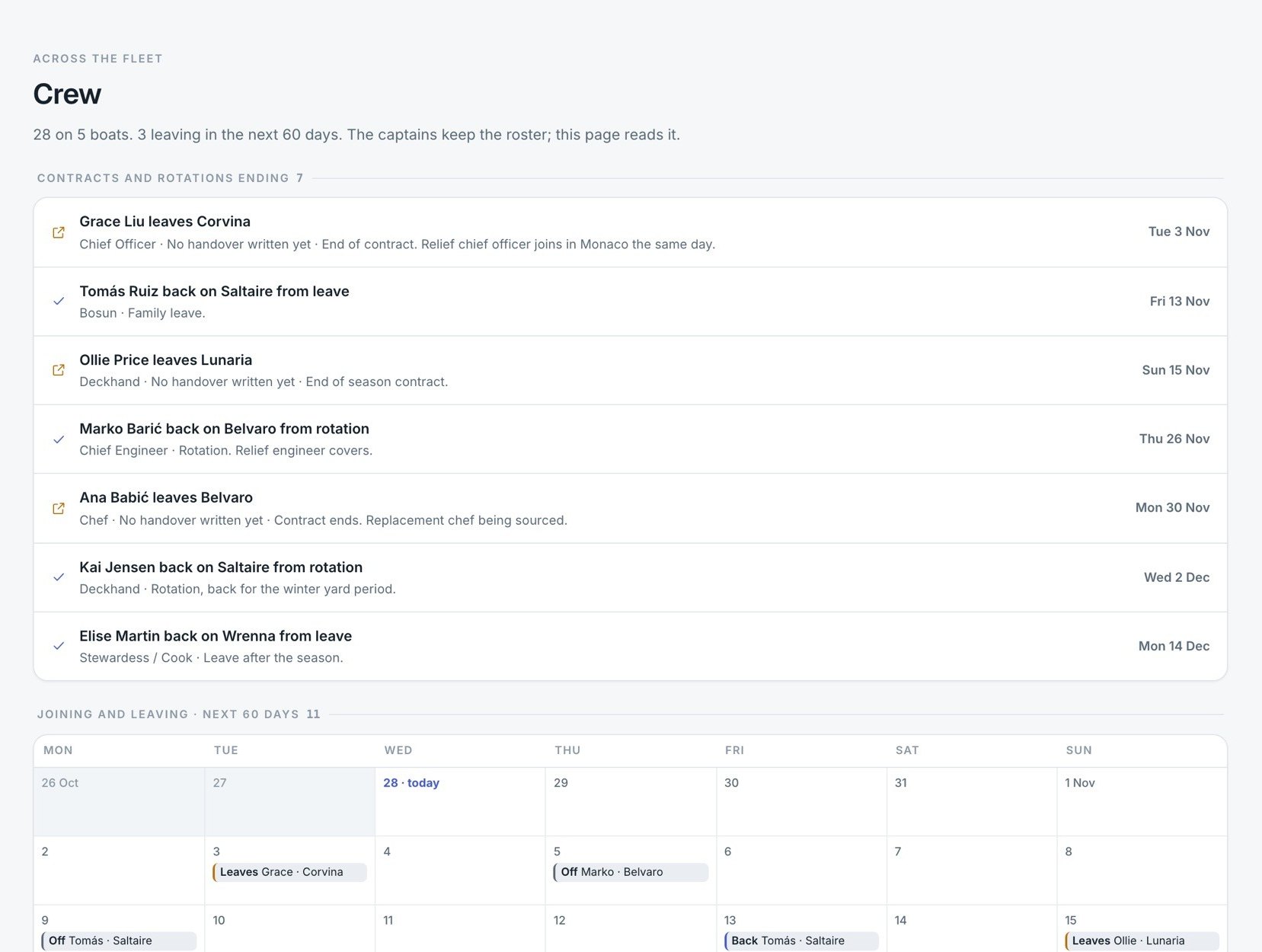
- Ashore, the management company sees contracts and rotations ending, who is leaving with no handover written yet, and a calendar of joining and leaving for the next 60 days.
Said plainly. Kodo is not payroll and not a manning agency. It does not decide what your agreements say; it keeps what they say, and who decided what. Clause by clause detail is on MLC 2006 in Kodo.
Sources
- ILO, Maritime Labour Convention, 2006, as amended: Article II (scope), Regulation 2.3 and Standard A2.3 (hours of work and rest), Regulation 2.4 and Standard A2.4 (annual leave and shore leave), Regulation 2.5 and Standard A2.5.1 (repatriation).
- MCA, MSN 1877 (M) Amendment 2, hours of work and entitlement to leave (UK flag).