
The four things it has to hold
On a yacht of 30 to 80 m the engineering record is spread across the maker's manuals, a maintenance program, the engine room log, a parts list and the chief engineer's own notes. Maintenance software is there to keep four things together, so the next engineer can trace any machine's history.
| Part | What it should do |
|---|---|
| Planned maintenance | Every machine listed, each job with its interval and when it was last done, and what is overdue or due this week shown first, by department. |
| Running hours | Readings taken on a fixed rhythm, kept with who took them, and jobs due by hours, by the calendar or whichever comes first. |
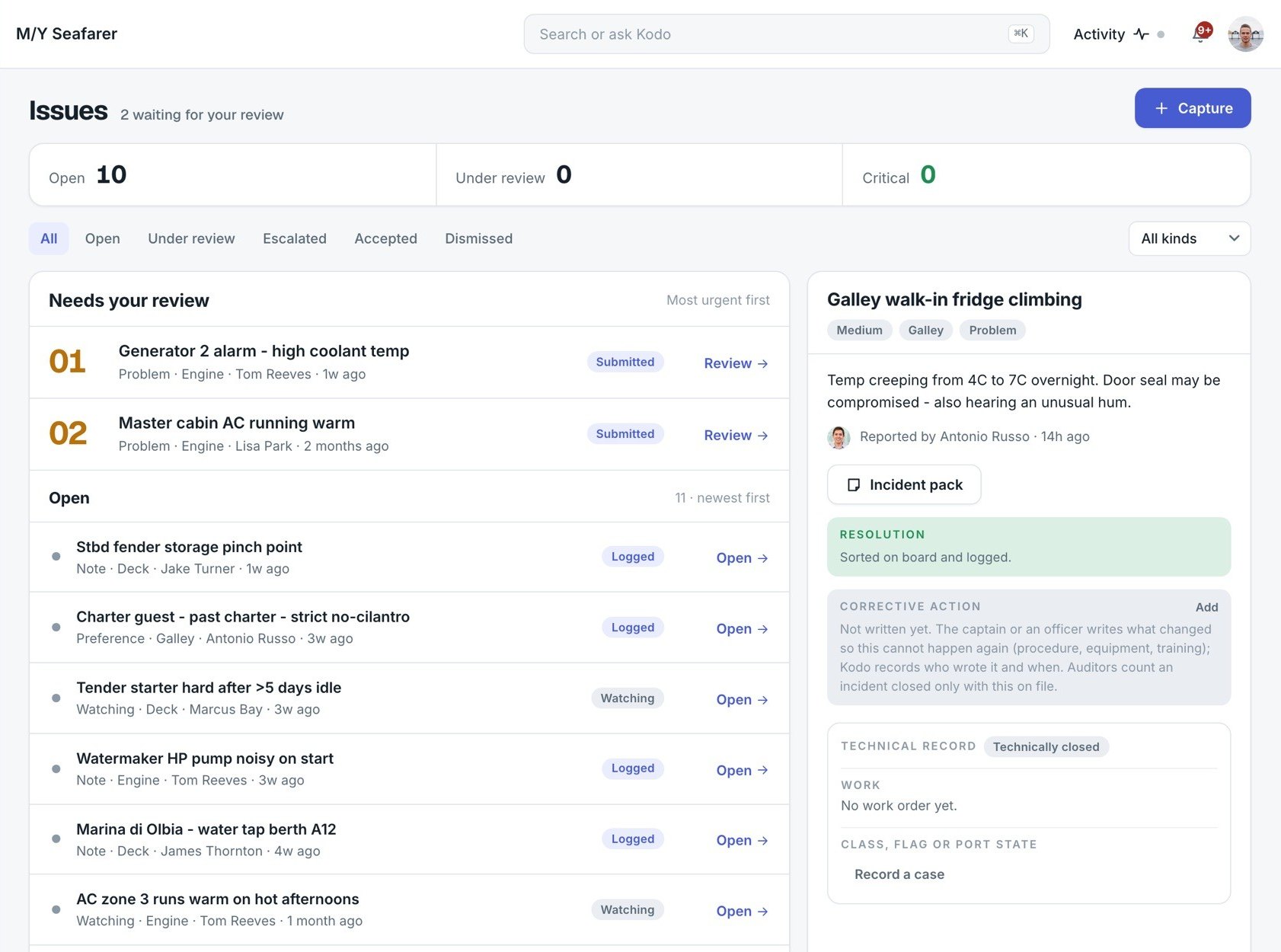
| Faults | Anyone aboard can report a fault with a photo. It is reviewed, worked, and closed with what was done and what changed so it does not happen again. |
| Parts | Stock that moves only through recorded movements, the part used booked against the job, and critical spares shown when they fall below their minimum. |
Planned maintenance: calendar, hours, or both
Machinery that wears with use, such as main engines, generators and watermakers, follows the maker's interval in running hours, usually with a time limit for when it sits idle. Safety equipment and hull items follow the calendar. A good system lets each job use whichever applies, and counts it from a fixed date or from the day it was last done.
The ISM Code asks the company to keep the ship and her equipment maintained and to keep records of it, and to identify equipment whose sudden failure could cause a hazardous situation (section 10). Class societies that accept a planned maintenance scheme for machinery survey follow IACS Unified Requirement Z20. Your class and flag decide what applies to your yacht. Our planned maintenance guide goes into the method.
Running hours
Running hours are only useful if they are read regularly and checked. Watch for three things: a reading lower than the last one, a meter that has been changed, and a machine nobody has read for weeks. Each should be visible, not quietly accepted.
Faults, from the report to the close-out
- Report. Whoever sees it logs it with a photo, from a phone.
- Review. The head of department accepts it as a job, escalates it to the captain, or dismisses it with a reason.
- Work. It sits on the department's list. Putting it off needs a reason.
- Parts and suppliers. Parts come out of stores against the job; a contractor's report is kept with it.
- Close-out. Someone other than the person who did the repair checks it and records the corrective action.
What a surveyor wants to see
A list of the machinery with a clear way to identify each item, the plan with its intervals, and a record of each job done with the date, the running hours, what was found and who signed it. Postponements with their reasons. Critical equipment and its standby tests. If you can print one machine's history in a minute, you are in good shape.
See how Kodo does it
Maintenance in Kodo Yachts sits on the same record as the crew, the logbook and the money, so a fault, the part used, the supplier's report and who signed it off stay together.
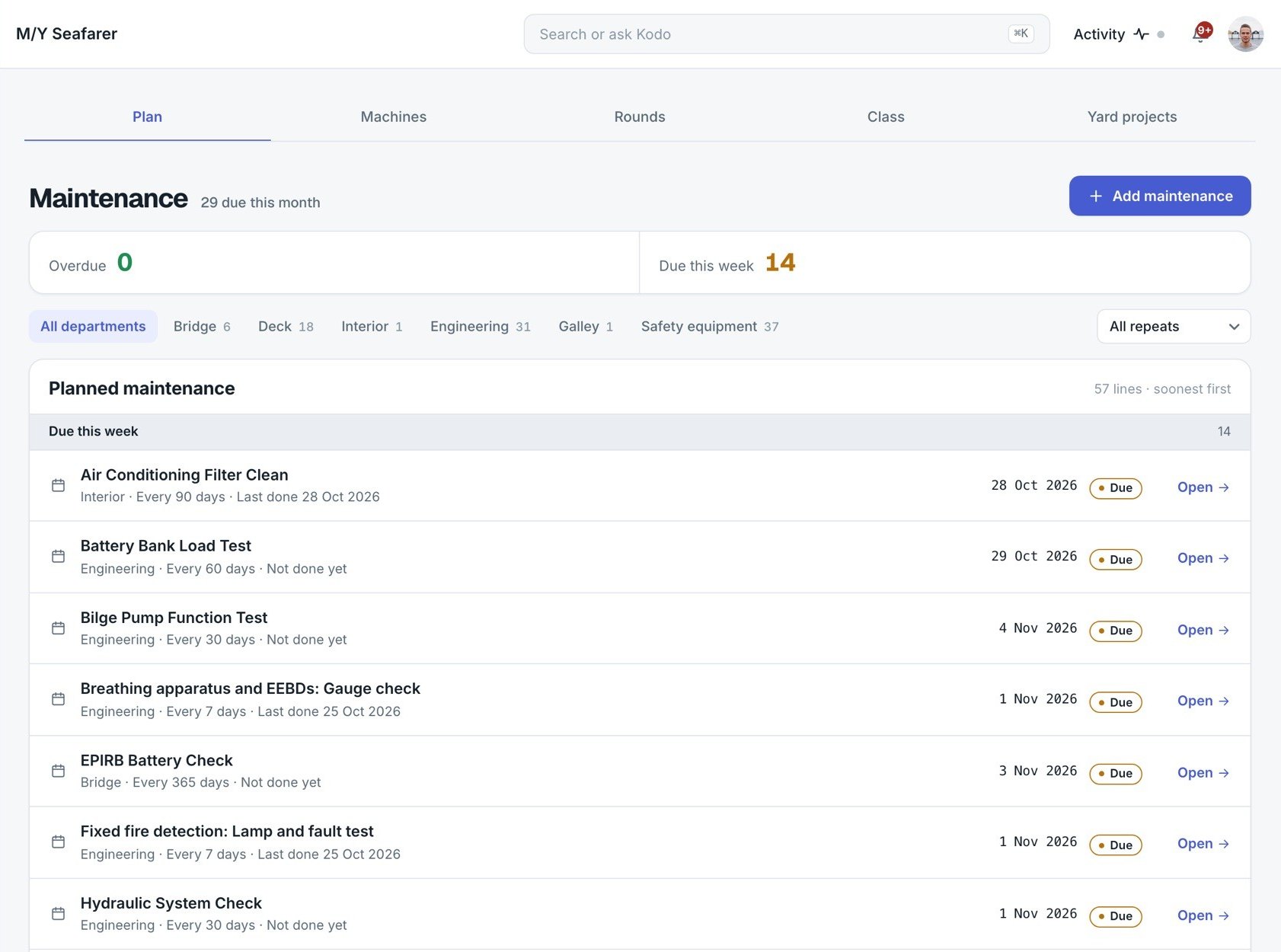
- The plan: each job repeats by days, calendar months, running hours, whichever comes first, or by uses such as starts or lifts. There is no grace period: a job past its due point is overdue.
- Running hours: every reading is kept with where it came from. A lower reading needs a reason, a meter change keeps the lifetime hours, a machine not read lately shows as stale, and an hours job shows the date it is likely due from recent use. The daily round can be saved without signal.
- Faults: reported with a photo by anyone aboard, reviewed, and closed by the captain or an officer with a corrective action. A defect is verified by someone other than the person who repaired it.
- Parts: stock changes only through recorded movements, parts are booked against the job, and critical spares below their minimum are shown.
- Suppliers: a contractor emails the yacht's own Kodo address, and the report waits for review already matched to the open fault it names.
- For class: each machine's history downloads as a PDF or a spreadsheet, and the annual report to class is prepared as a PDF.
Said plainly. Kodo is not a class-approved planned maintenance scheme and holds no class, flag or IMO approval. If your main need is a deep, hour-based system for a large engineering department, compare Kodo against a dedicated system such as those in our comparison before you decide. Coming from another system? Send us what you can export and we move it across with you. More on the maintenance page.
Sources
- International Safety Management (ISM) Code, IMO Resolution A.741(18), as amended: section 10 (maintenance of the ship and equipment).
- IACS Unified Requirement Z20, Planned Maintenance Scheme (PMS) for machinery, Rev.1 July 2018.